Account statement
 Salient features
-
Financial terms explained: The statement includes a section with definitions for key financial concepts, such as profit/loss calculations, financing costs, and margin-related terms.
-
Margin
The required collateral to open and maintain a leveraged position. and risk analysis: You will find a detailed breakdown of your account's margin. This specifies the amount of margin currently in use, the amount available for trading, the ratio of used-to-available margin, and the specific account threshold at which positions may be automatically closed. -
Detailed open positions: This section lists all your open positions and the open trades that make up those positions. For each position, it provides:
-
The position size - aggregated value at the instrument level with total value of Units (Size) of open position and its VWAP rate
-
Full list of contributing transactions with:
-
The price and time at which the transaction was opened
-
The current market price
-
A valuation of each transaction in the home currency of your account
-
The specific midpoint currency exchange rate applied to convert the mark-to-market (MtM) value of each open transaction into your account home currency.
-
The price difference between the current price and your open price
-
The unrealized profit/loss in your home currency
-
-
-
Transaction-level history: The statement contains a complete log of all individual trading activities during the period. For each trade, it provides:
-
The units
-
The execution price and time
-
Whether the trade was opened, closed or partially closed
-
The commission paid if the raw pricing plus commission product applies to your account
-
The estimated half spread cost
-
The realized profit and loss
-
The profit and loss conversion cost, which is already included in realized profit or loss (RPL) for closed transactions, performed using prevailing exchange rates inclusive of a currency conversion fee as determined by OANDA
-
-
Itemized cash movements and fees: A granular, itemized list of charges is provided. This includes:
-
Financing costs
-
Commissions
-
Inactivity fees
-
Deposit and withdrawal fees
-
-
Itemized list of all cash adjustments, including:
-
General adjustments
-
Cash adjustment related with particular trade corrections
-
Elite Trader rebates (if applicable to your account)
-
Promotions (if applicable to your account)
-
-
Precise account and period details: The statement specifies key administrative details for accurate record-keeping:
-
The exact reporting period, including the start/end date, timestamp, and time zone
-
Your account's type (e.g., individual, joint)
-
Statement definitions
Opening Unrealized P/L & Closing Unrealized P/L in Account Summary section
These values are aggregated at the account level and calculated based on the opposite-side Top-of-Book (ToB) price, which represents the volume available in the first band of our Depth-of-Market pricing ladder. This UPL calculation assumes that trades and positions would be liquidated in one or more transactions, each with a size less than or equal to the Top-of-Book volume. BidThe prevailing buy price. prices are used to value long net open positions, and ask prices are used for short net open positions.
Net Realized P/L
Profit or loss from trades that were closed during the statement period.
Financing settled
Represents the financing charges or credits applied to open positions. For positions held past 5:00 PM ET, financing is calculated and settled daily. For positions closed prior to 5:00 PM ET, a pro-rated financing charge or credit is calculated for the exact hours the position was held during that trading day and settled immediately in cash upon closure.
Promotions
Shows the amount credited if the account is eligible to participate.
Interest on Unused Margin
Interest received during the statement period on unused margin balance, if eligible.
Margin used
-
The amount of collateral utilized to maintain open positions.
-
Dynamically converted from the instrument currency into your account home currency using the opposite-sided Top-of-Book exchange rate (ask rates are applied to buy/long positions, and bid rates are applied to sell/short positions).
Free Margin available
The amount available to open new positions if positive.
Opening NAV (Equity) and Closing NAV (Equity)
Represent the account’s net asset value at the beginning and end of the statement period respectively, including both realized and unrealized P/L.
Charges
Includes Financing charges, Commissions, Inactivity fee, Deposits or Withdrawals fees as applicable.
Adjustments
Includes general adjustments, positive or negative trade corrections, Elite Trader rebates credited and promotions - credited or debited based on account-specific agreements.
Margin Utilization Ratio
-
The ratio of your Margin used to your Net Asset Value (NAV).
-
Ratio of 50% or higher means the account is on Margin Call.
-
Ratio of 100% or higher triggers the MCO procedure.
For more information on margin rules, requirements and calculations, refer to this topic.
-
Rounding Disclosure: Individual account debit/credit postings may not yet always be appropriately, and most fairly, rounded to the precision of the most minor currency unit (e.g. one cent for USD and one JPY integer), using round-to-even (aka "banker's rounding") methodology. All of these individual amounts and the respective sub-totals, are rounded in this manner for presentation in the Statement, but this may result in some relatively minor rounding differences between the sum of rounded individual transaction amounts and rounded sums of unrounded individual transaction amounts in the Charges and Balance sections.
-
Please note that for valuation purposes, all open positions are valued at the bid/offer price at 05:00 pm ET.
-
An overnight interest adjustment or rollover will be applied to your account if you hold your position through 5:00 pm ET.
-
An introducing broker may be compensated on a per transaction basis or on another basis.
-
OANDA may charge a mark-up or mark-down or commission in connection with your transaction.
Calculations
Open Positions section
Individual positions
The Open Positions section provides the following information for each open trade:
-
The instrument.
-
The position ID.
-
The position direction.
-
The position size.
-
The open price.
-
The current market price, evaluated using the opposite-sided Top-of-Book rate.
-
The market price type (bid or ask).
-
The open position mark-to-market value in home currency.
-
The quote-to-home currency conversion rate, which is a neutral midpoint exchange rate applied to convert the mark-to-market value of each trade into your account home currency.
-
The price difference (current - open).
-
The unrealized profit/loss in home currency.

How the Open Position Mark-to-Market Value column is calculated
The Open Position Mark-to-Market Value column represents the total value of your open units, converted into the home currency of your account. The formula uses the Position Size (Units) and the Current Market Price:
Position Size x Current Market Price x Quote to Home CurrencyA medium of exchange for goods and services, often issued and regulated by a central authority. conversion rate = Open Position Value in Home Currency
As shown in the screenshot above, let’s look at the first AUD/USD trade:
-
Position Size (Units): 508 units
-
Current Market Price: 0.66716
-
Quote to Home Currency Conversion Rate: 1
-
Open Position Mark-to-Market Value: 508 x 0.66716 x 1 = 338.92
How the Price Difference (Current - Open) column is calculated
The Price Difference (Current - Open) column shows the change in value for a single unit of the instrument from the time the trade was opened to the current reporting period. This figure is a primary component used to determine your unrealized profit or loss.
The formula uses the subtraction of the price you paid (or sold at) from the current market valuation:
Current Market Price - Open Price = Price Difference
As shown in the screenshot above, let’s look at the first AUD/USD trade:
-
Current Market Price: 0.66716
-
Open Price: 0.64979
-
Price Difference (Current - Open): 0.66716 - 0.64979 = 0.01737
How the Unrealized Profit/Loss column is calculated
The Unrealized Profit/Loss represents the current potential gain or loss on an open position.
The formula uses the price difference of the instrument and multiplies it by the total number of units you are holding.
Price Difference (Current - Open) x Position Size (Units) x Quote to Home Currency Conversion Rate = Unrealized Profit/Loss
The quote currency equals the home currency
As shown in the screenshot above, let’s look at the first AUD/USD trade:
-
Position Size (Units): 508 Units
-
Price Difference (Current - Open): 0.01737
-
Quote to Home Currency Conversion Rate: 1 (Since the quote currency is already USD)
-
Unrealized Profit/Loss (USD): 0.01737 x 508 x 1= 8.82
The quote currency is not the same as the home currency

As shown in the screenshot above, let’s look at the USD/JPY trade:
-
Position Size (Units): 700 Units
-
Price Difference (Current - Open): 0.2
-
Quote to Home Currency Conversion Rate: 0.0063596
This represents the sided Top-of-Book exchange rate. Because the transaction has an unrealized profit, the conservative bid rate is used to convert the value into your account’s home currency. -
Unrealized Profit/Loss (USD): 700 x 0,2 x 0.0063596 = 0,89
Aggregated positions
The Open Positions section provides the following cumulative information for each instrument in the total position row:
-
The instrument.
-
The position ID.
-
The position direction.
-
The position size.
-
The open price.
-
The unrealized profit/loss.
How the Open Price column is calculated in the total position row
The Open Price column in the total position row is the Volume Weighted Average Open Price of all currently open individual trades for that specific instrument.
Instead of a simple average, this calculation factors in the TradeThe actual execution of buying or selling an asset, resulting in a completed transaction. Size (Units) of each separate entry (the Open Price column) to provide a more accurate "break-even" price for the total open position.
As shown in the screenshot above, the total position row's Open Price (0.65805) is calculated by multiplying each trade's price by its size, summing those totals, and dividing by the total units (1,860).
How the Unrealized Profit/Loss column is calculated in the total position row
The Unrealized Profit/Loss column in the total position row is the sum of the unrealized gains or losses from every individual open trade within that specific instrument.
As shown in the screenshot above, the total position row's Unrealized Profit/Loss (16,93) is calculated by adding the three individual trade values together (8.82 + 6.32 + 1.79).
Trading Summary section
The Trading Summary section provides the following information for each position:
-
The instrument.
-
The order type
-
The position direction.
-
The position ID.
-
The position size.
-
The open price.
-
The trade execution date and time
-
The open/close - opening or closing trade.
-
The commission paid - applicable for product type "Raw pricing plus Commission".
-
The estimated spread cost disclosure - half-spread for the given trade quantity.
-
The realized profit/loss.
-
The profit/loss home conversion cost
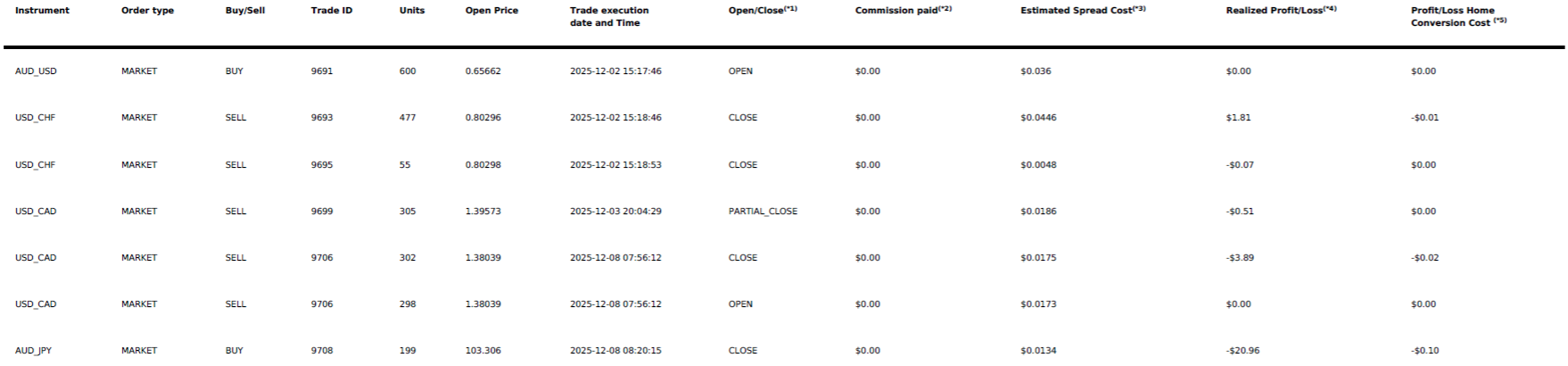
How the Realized Profit/Loss column is calculated
The Realized Profit/Loss column in the Trading Summary shows the final financial result of trades that were closed or partially closed during the statement period, including any applicable currency conversion costs (the Profit/Loss Home Conversion Cost column)
The formula for determining this value is the difference between the price at which you entered the market and the price at which you exited, multiplied by the number of units traded:
-
For buy (long) trades: (Exit price - entry price) x trade units
-
For sell (short) trades: (Entry price - exit price) x trade units
-
Account rules:
-
Retail accounts (Personal, Joint, Business or IRA accounts): Trades are closed following the First-In, First-Out (FIFO) rule, meaning the oldest open position is closed first.
-
ECP (Eligible Contract Participant) accounts: Clients are not restricted by FIFO and can choose to close any specific open trade against another for a given instrument. The Realized P/L column is then calculated based on the specific trades selected by the user.
-
-
Currency conversion charge: Currency conversion charge presented here is already included in realized profit or loss for your closed transaction. Conversions to the account’s home currency units are performed using prevailing exchange rates inclusive of a currency conversion fee as notified by OANDA from time to time.
-
Commissions: If your account uses the raw pricing plus commission pricing model, any commissions paid are listed separately and are not deducted from the Realized Profit/Loss column.
How the Profit/Loss Home Conversion Cost column is calculated
When you trade an instrument that is not priced in your account's home currency (e.g., USD), the profit or loss must be converted back to your account’s currency. This Profit/Loss Home Conversion Cost column represents the specific cost associated with that currency conversion. For more information on the home currency conversion, refer to this topic.
Rounding methodology: OANDA uses "banker's rounding" (round-to-even) to the smallest currency unit (e.g., one cent for USD).
