Trading ETF CFDs with OANDA Europe Limited
As with all CFDs, trading ETF CFDs means you will not acquire any physical holdings of ETFs, but you will make gains or suffer losses as a result of price movements in the underlying asset to which you have an indirect exposure.
 How can I trade ETF CFDs?
To trade ETF CFDs:
-
You must meet the following eligibility requirements:
-
You must have a Retail or Professional live account.
-
You must not be a resident of the EU, as EU residents are currently not eligible.
-
-
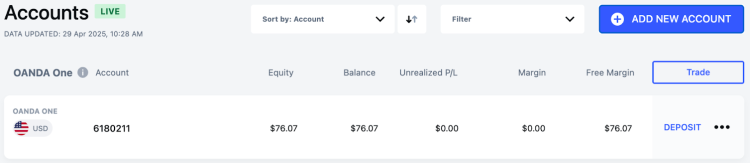
You may have an OANDA One sub-account in GBP created by default. If not, or if you would like an OANDA One sub-account in a different currency, go to Step 3. The following image show how to identify OANDA One sub-accounts in the HUB:
-
You can create OANDA One sub-accounts denominated in any of the following currencies: EUR, USD, GBP & CHF. You can have a maximum of 3 OANDA One accounts. These sub-accounts will have ETF CFDs trading enabled only if you have completed the activation process.
-
Activate ETF CFDs on your OANDA One sub-account. Follow this guide.
Demo account users can trade on more than 50 Share CFDs and more than 30 ETF CFDs provided by default. There is no activation process to add more Share CFDs or ETF CFDs to the demo account. -
Use your OANDA One sub-account to trade ETF CFDs on MetaTrader 5 platforms (desktop, web, tablet and mobile), TradingView platforms (desktop, web, tablet/mobile) and OANDA mobile app.
What are the minimum and maximum order sizes?
The minimum order size for ETF CFDs is 1 lot, which is equal to 1 ETF. You cannot take fractional positions. The maximum order size depends on the instrument. If you attempt an order that exceeds the maximum order size, the trade ticket in the MT5 platform will not allow you to enter that amount. On the OANDA mobile app, if you exceed the maximum order size, you will not be able to submit the order.
What is the maximum position size?
OANDA allows clients to open positions up to a maximum position size on a per symbol basis. This maximum exposure is on a per client basis and therefore applies to cumulative positions over all your OANDA One trading accounts. This maximum position size per instrument is shown on the trading platform. In MT5, this is defined as the Volume Limit in the symbol specification. In the OANDA mobile platform it is noted as Maximum Client ExposureThe current market value of all the positions a trader holds. Higher exposure magnifies potential gains or losses. in the Instrument Information section. TradingView currently does not display these values on its platform.
What is the applicable exchange pricing?
For live accounts, the price you see on the trading platform is the current exchange price.
How are commissions calculated for ETF CFDs?
When you trade ETF CFDs, we charge a commission on opening as well as closing of the position. There is no minimum commission amount. For a full list of available ETF CFDs and the applicable commission, refer to our website.
-
Commission is charged in the currency of the ETF CFDs and then converted to your account currency using the current currency conversion rates.
-
This is applicable to both Retail and Professional account types.
For example, a 100 unit long trade in ABC ETF at a price of $65.28 would incur a commission of $3.9168 if the commission rate was 0.06%, as shown in the following calculation:
100 (units) x $65.28 (price) x 0.06% = $3.9168
When you close the position, you will be charged commission on the closing value as well.
Is leverage trading available?
OANDA offers leveraged trading for ETF CFDs. For margin rates, refer to our website.
What are the hours of operation?
Please refer to our website for trading hours of ETF CFDs.
Why am I not able to open new trades or short sell certain instruments?
Certain market conditions may affect an instrument’s availability. OANDA may decide to make them ‘close-only’ or ‘long-only’. Instruments that are not available for full trading are listed in the Trading Status Exceptions table on our website. For more information, refer to our Terms of Business. An instrument’s trade status is visible in our platforms as shown in the following images:
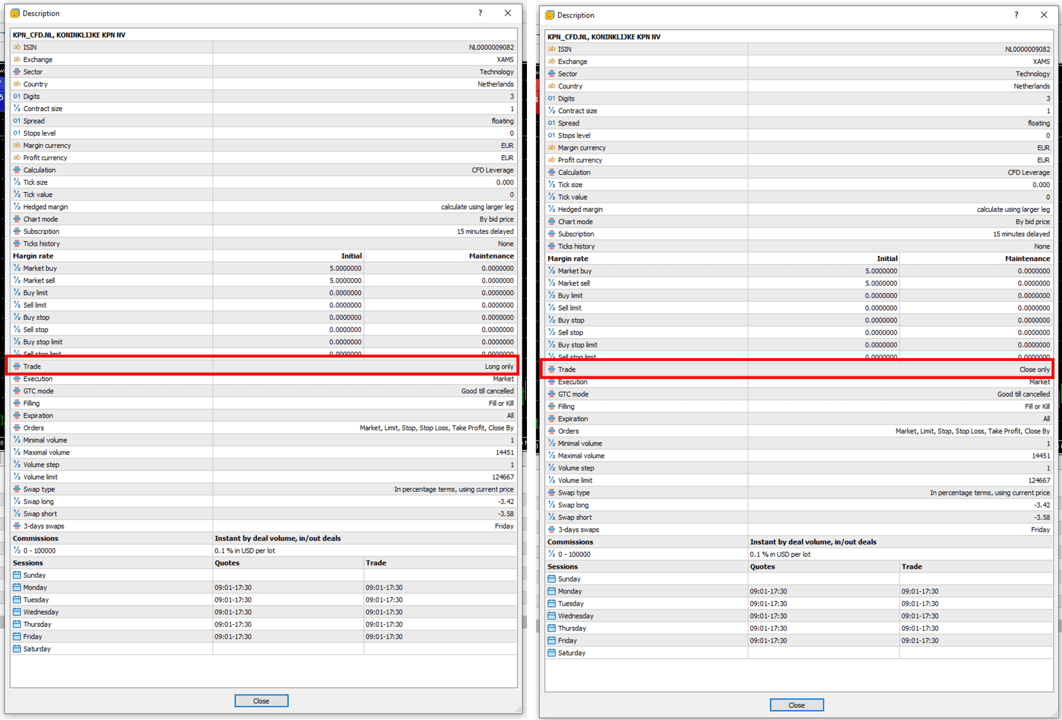
In case of ETF CFDs, if the tax declaration submitted by you has been invalidated or has expired, the instruments will be set to ‘close-only’ and any new orders to enter the market will be rejected. You must submit a new tax declaration to start trading again. If you do not submit a new tax declaration within 25 days, your ETF CFD positions will be automatically closed. You will then be required to submit a new tax declaration to resume full trading. For more information on tax declaration, refer to this FAQ.
What are corporate actions?
Corporate actions are events carried out by a publicly traded company that have an impact on its shareholders. These events can also impact your ETF holding. Examples of corporate actions include the following:
-
Dividends
-
Stock splits
-
Rights issues
-
Mergers, takeovers & acquisitions
-
Spin-offs
-
Bonus issues
When will my account be debited or credited in line with a corporate action?
Adjustments are typically applied to your account prior to market open on ex-date. While we strive to process these prior to market open, the exact timing for some events depends on our liquidity provider. We will pass on the debit or credit to you as soon as we receive it. You can view corporate action debits and credits in your account statements. The following table explains how to identify transactions related to corporate actions:
|
Corporate Action |
Comment in Account Statement |
|
Dividend |
|
|
Split_adj |
|
|
Spinoff_adj |
|
|
Rights_adj |
|
|
Acq_merg_adj |
|
|
Bonus_adj |
|
|
Stockdiv_adj |
|
|
Tax |
|
|
Tax_equivalent |
The comment you see in your statement and on the MT5 platform will be followed by the trade ID number of the transaction to which the charge applies.
Why do you make deductions when you calculate dividend or other corporate action adjustments?
The following two deductions apply to long positions:
-
Tax: Dividends on some ETF CFDs may be subject to taxes, depending on the jurisdiction where the ETF is listed. Tax treatment of dividends can differ depending on your country of tax residency and whether tax treaties are in place.
-
Tax Equivalent: For ETF CFDs on companies listed in jurisdictions that do not apply withholding taxes, while no Tax (as described above) will be deducted, there may still be a deduction of Tax Equivalent. This is because for the ETF CFD positions you hold, our liquidity providers hold an equivalent position in the underlying shares as a hedge. Thus, our liquidity providers receive the actual dividend which is subject to tax. Our liquidity providers pass this tax cost on to us, which we then pass on to you when a dividend credit is made on your account. In these cases, the difference between the gross and the net dividend value is termed as tax equivalent.
For more information on the applicable rates of deductions, refer to our website. On short positions, there are no tax or tax equivalent adjustments.
How do corporate actions impact me?
Refer to our website to understand how corporate actions impact you. Additionally, the following examples may help you understand the potential implications of corporate actions.
-
These examples are for illustrative purposes only and may not apply to all scenarios.
-
In general, we would attempt to make cash adjustment or position adjustment or both to reflect the economic value of the corporate actions.
-
Any charges or tax equivalents applied against us by our liquidity providers will be passed on while calculating the required adjustments.
-
In the case of U.S ETF CFDs, there may be tax implications. When applicable, the tax rate used to calculate taxes will be determined based on the tax declaration you submitted at the time of activation.
Impact of dividends
In this hypothetical example, you are holding a long position of 1 ETF CFD of ABC which is trading at $400. A dividend of $10 per ETF is announced. On the ex-dividend date, the value of the CFD would, in theory, fall to $390.
We will credit your account by the value of the dividend and debit it by any applicable tax or tax equivalent. These will appear as two separate cash transactions.
Credit applied = $10 (value of the dividend)
Charges applied = $10 x 30% = $3 (tax or tax equivalent as applicable on these CFDs)
The net effect of the two transactions will be a credit of $7 applied to your account.
Conversely, if you are holding a short CFD position, on the day of the ex-dividend date the position would see an increase in value.OANDA would debit the account by the amount of the gross dividend.
Impact of stock dividends
In this hypothetical example, you are holding a long position of 150 ETF CFDs of ABC. Each CFD is trading at $400. A stock dividend is announced, granting 1 additional CFD for every 100 ETF CFDs held. On the ex-dividend date, the value of the CFD would, in theory, fall to $396.04.
Since you hold 150 CFDs, you’re entitled to a dividend equivalent to 1.5 CFDs (150 ÷ 100 = 1.5).
We will credit your account with cash equivalent to the stock dividend.
Credit applied = Cash equivalent of the stock dividend
Credit applied = $396.04 x 1.5
Credit applied = $594.06
Conversely, if you are holding a short CFD position on the day of the ex-dividend date, you would see an increase in value. Thus, cash equivalent to the dividend will be deducted from your account.
Impact of bonus issues
A bonus issue is where a company issues additional free shares to existing shareholders. It is similar to a stock dividend, but the funding for the bonus issue comes from a company’s retained earnings or capital instead of income. The impact of bonus issues is the same as that of stock dividends and your account will be impacted the same.
Impact of stock splits
Example 1
In this hypothetical example, you are holding a long position of 10 ETF CFDs of ABC purchased at $400 per ETF CFD. A 2 for 1 stock split is announced.
As a result, we will close your position of 10 ABC ETF CFDs at $400 per ETF CFD and open a new position of 20 ABC ETF CFDs at $200 per ETF CFD. The notional value of your position, before and after this split, remains the same.
A short position will be similarly impacted.
Example 2
In this hypothetical example, you are holding a long position of 5 ETF CFDs in ABC, purchased at $400 per ETF CFD. It announces a 3 for 2 stock split.
We will close your position of 5 ABC CFDs at $400 per ETF CFD and open a new position of 7 ABC ETF CFDs at $266.67 per ETF CFD.
When the CFDs are split, there is a fractional position of 0.5 ETF CFD, which is closed in this split operation and you will receive cash compensation for that closure noted on your account as "split adjustment". The compensation will be the P&L for that 0.5 ETF CFD. This P&L would be the difference between the purchase price and the price at the time of the split.
A short ETF CFD position would be similarly impacted.
Impact of reverse stock splits
Example 1
In this hypothetical example, you are holding a long position of 10 ETF CFDs of
ABC purchased at $50 per ETF CFD. It announces a 1 for 2 reverse stock split.
As a result, we will close your position of 10 ABC ETF CFDs at $50 per ETF CFD and open a new position of 5 ABC ETF CFDs at $100 per ETF CFD. The notional value of your position, before and after the reverse split, remains the same.
A short position will be similarly impacted.
Example 2
In this hypothetical example, you are holding a long position of 5 ABC ETF CFDs purchased at $50 per ETF CFD. It announces a 2 for 3 reverse stock split.
We will close your position of 5 ABC ETF CFDs at $50 per ETF CFD and open a new position of 3 ABC ETF CFDs at $75 per ETF CFD. When the CFDs are split, there is a remaining fractional position of 0.33 ETF CFDs, which are closed in this split operation and you will receive cash compensation for that closure noted on your account as "split adjustment". The compensation will be the P&L for that 0.33 ETF CFD. This P&L would be the difference between the purchase price and the price at the time of the split.
A short ETF CFD position would be similarly impacted.
Impact of rights issues
In this hypothetical example, you are holding a long position of 10 ABC ETF CFDs. ABC announces a rights issue of 1:1.
OANDA offers ETF CFDs and not the cash ETFs and therefore you are not the holder of the 10 rights that would be made available. Consequently, OANDA will process a cash adjustment credit to your account that will offset the price move in the market attributed to the Rights Issue on ex-date. This adjustment will be posted to your account before the market opens on ex-date. This will ensure your account is not negatively impacted by this event. Conversely, if you are holding a short position, we will debit your account a cash adjustment.
Impact of acquisitions and mergers
Example 1 - Merger for cash
In this hypothetical example, you are holding a long position of 900 XYZ ETF CFDs. XYZ is merging with ABC. As per the merger agreement, XYZ holders shall receive cash consideration in exchange for their units of $10 per share.
We would close your position of 900 XYZ ETF CFDs at $10 per ETF CFD according to the terms of the merger. Short positions would be similarly impacted.
Example 2 - Merger for shares
In this hypothetical example, you are holding a long position of 900 XYZ ETF CFDs. XYZ is merging with ABC. As per the merger agreement, XYZ holders shall have their units exchanged on 1:1 basis for ABC units.
We would close your position of 900 ETF CFDs by cash settling your holding; the position will be closed based upon the ABC price as defined in the terms of the merger. In case the merger agreement does not detail the ABC price, we would consider the market price on the effective date of the merger.
We would close your position of 900 XYZ ETF CFDs at ABC’s market price and credit or debit your account accordingly. Short positions would be similarly impacted.
Impact of spin offs
In this hypothetical example, you are holding a long position of 10 ETF CFDs of XYZ. XYZ announces a spin-off, whereby holders of XYZ units shall receive 10 units of spin-off company ABC on a 1:1 basis.
At OANDA, we would not pass on a new ETF position in the spin off instrument however, similar to the rights issue processing, we would make a cash adjustment credit to your account that would offset the move in the market attributed to the corporate action event. Conversely, if you are holding a short CFD position in XYZ, we will debit your account with a cash adjustment.